
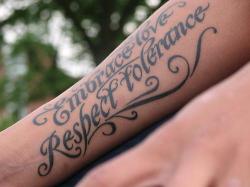
An Englishman well known for his tattoos
Initial reports suggested that the visitor had also voiced disrespect towards Buddhism although the man later declared that he was himself a Buddhist and that far from being an insult, the tattoo demonstrated his affiliation to the religion. Whatever the truth behind the conflicting reports, this is a good example of how tourism can result in cultural misunderstandings.
Of course, part of the reason that we travel is to experience different cultures.
That entails being sensitive to the communities we visit and ensuring that we are aware of different cultural norms. On the other side, countries like Sri Lanka and Maldives which open themselves up to large scale tourism need to be prepared for the fact that people with very different perspectives and values will visit their shores.
Glossy marketing and the relative ease of global transport can mask the fact that tourist destinations often have very different customs to those found in liberal western cities.

Traditional Stilt Fishermen in Sri Lanka
Had the visitor read our Travel Advice
he would have seen that we caution against causing perceived insult to
Buddhism. This advice has now been updated to include a specific
reference to tattoos. The man with the tattoo of Buddha claimed that he
was exercising his right to free expression.
That’s a right strongly promoted and defended by the UK government.
We also recognise that such freedoms are necessarily limited where such
expression has a negative impact on others (e.g. racist language).
Arguably a better informed traveller might have had the awareness to
cover his tattoo while visiting a country with strong views on Buddhist
iconography.

Eid Celebration in Maldives
But while visitors need to be
better informed and respectful of the countries they are visiting, a
degree of understanding and tolerance is also desirable on the part of
the hosts. In Maldives, for example, this means having to balance
traditional Islamic customs which outlaw alcohol and revealing clothing
with providing a relaxed environment for tourists who pay a lot of money
for a well-earned holiday in paradise.
This has been managed in Maldives through a clear separation between
resort islands and those inhabited by Maldivians, but the cultural
differences have nevertheless given rise to tensions.
In Sri Lanka, while many see the economic opportunities offered by
increasing visitor numbers, there are also concerns amongst some local
people that traditional livelihoods and cultures are coming under
threat. And while many tourists enjoy exploring new destinations and
cultures, they also need to feel that they are safe and protected in
areas less accustomed to foreigners.
It’s
been reported that the decision to deny entry to the man with the
Buddha tattoo was made partly on the basis that his safety could have
been at risk.
That could well be the case, but if so, it tells a sad story about
the growing levels of religious anxiety in a country usually famed for
its hospitality towards visitors.
